

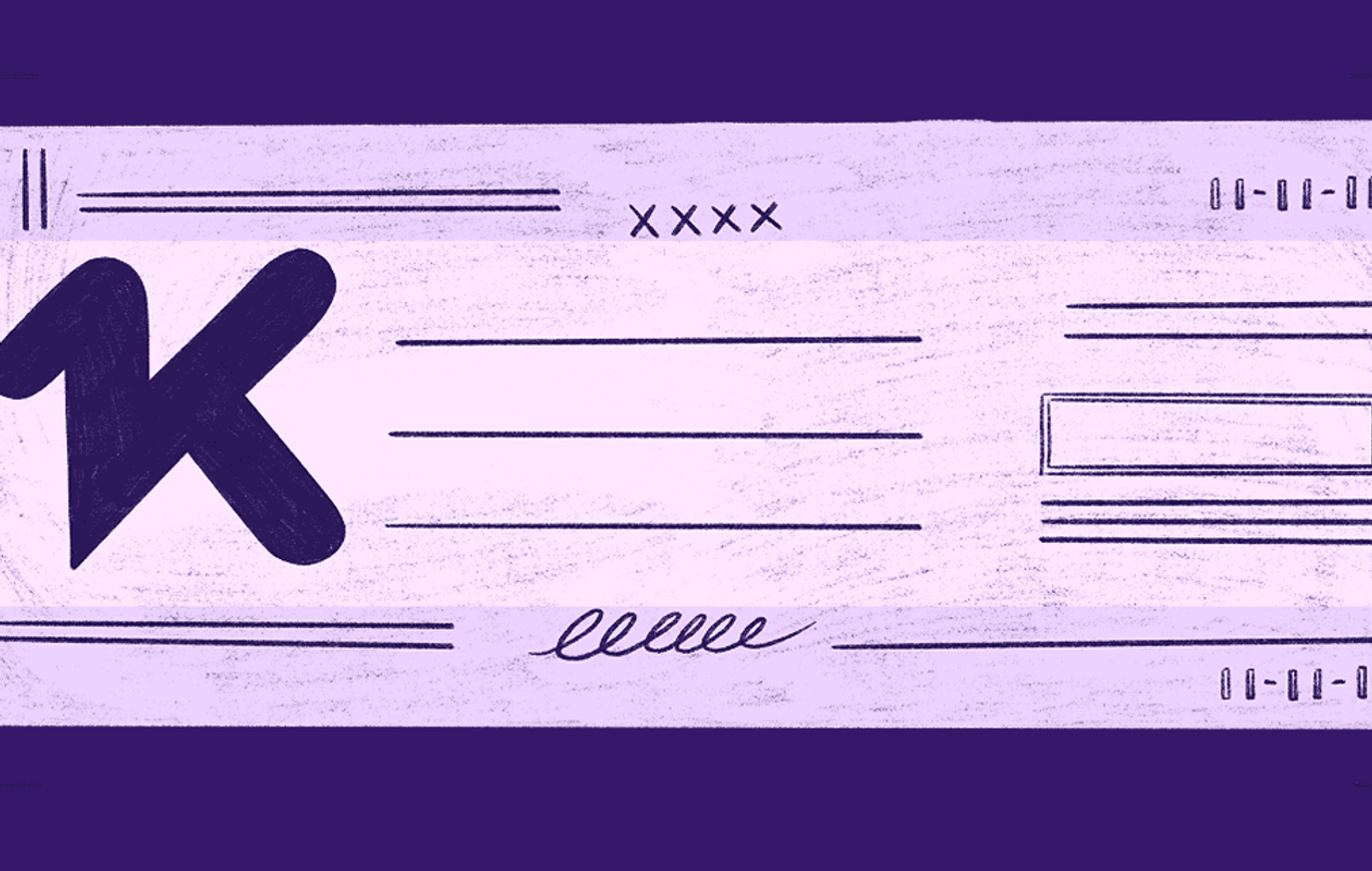
To write a cheque in Canada, enter the date, name of the person or business you are paying, payment amount in numbers and words, and your signature.
You can also add a memo explaining what the payment is for. Make sure you have enough money in your account to cover the cheque when it is deposited.
KOHO Prepaid Mastercard
KOHO Prepaid Mastercard is a credit card alternative that lets you spend money you already have.
With KOHO Prepaid Mastercard, you can:
Get instant approval with no credit check
Spend only the money you load onto your account
Pay no interest on your purchases
Earn up to 2% cash back
Use your card for in-store purchases, online shopping, and recurring payments
How Do You Fill Out a Cheque in Canada?
Most Canadian cheques have the same basic fields.
Here is how to complete each one.
1. Write the Date
Enter the date in the space near the top-right corner of the cheque.
Make sure the date is clear and follows the format shown on the cheque.
You can also write a future date if you want to create a post-dated cheque. A post-dated cheque should not be deposited before the date written on it.
2. Write the Name of the Person or Business
Find the line that says “Pay to the order of.”
Write the full name of the person or business receiving the money.
For example:
Pay to the order of: John Smith
Check the spelling before continuing. An incorrect name could create problems when the recipient tries to deposit the cheque.
3. Write the Amount in Numbers
Write the payment amount in the box beside the dollar sign.
For example, if you are paying $525.75, write:
$525.75
Include both dollars and cents.
4. Write the Amount in Words
Write the same amount in words on the line below the recipient's name.
For $525.75, you could write:
Five hundred twenty-five and 75/100 dollars
Payments Canada recommends including the amount in words because it provides a backup if the numerical amount is unclear. It is recommended rather than legally required.
Make sure the written amount and numerical amount match.
A difference between the two can cause a cheque to be rejected.
5. Add a Memo
The memo line is usually near the bottom-left corner.
You can use it to record why you are making the payment.
For example:
September rent
Invoice 1052
Tuition payment
Birthday gift
The memo is mainly for record-keeping.
6. Sign the Cheque
Sign your name on the signature line at the bottom-right.
Your signature authorizes your financial institution to make the payment.
Make sure your signature is reasonably consistent with the signature associated with your account. An irregular signature can be one reason a cheque is dishonoured.
Example of How to Write a $1,250 Cheque
Suppose you need to pay someone $1,250.
You could fill out the cheque like this:
Date: September 2, 2026
Pay to the order of: John Smith
Amount: $1,250.00
Amount in words: One thousand two hundred fifty and 00/100 dollars
Memo: September rent
Signature: Your signature
Before giving someone the cheque, review everything to make sure the information is correct.
Should You Use Pen to Write a Cheque?
Yes.
Payments Canada recommends using a ball-point or roller pen with black or blue ink when filling out a cheque by hand. Dark ink helps the information remain visible when the cheque is digitally scanned.
Avoid writing a cheque in pencil.
What Happens If You Make a Mistake on a Cheque?
If you make a major mistake, the safest option is usually to write VOID across the cheque and start again.
Do not give someone a cheque with unclear amounts, names or corrections.
If you already gave someone a cheque containing an error, contact them before they deposit it.
You may also be able to request a stop payment through your financial institution. A stop payment request does not necessarily guarantee that the cheque will be stopped if it has already been processed.
What Is a Void Cheque?
A void cheque is a cheque that cannot be used as a payment.
Write VOID clearly across the front without signing it.
Void cheques are commonly requested when setting up:
Direct deposit
Payroll deposits
Automatic bill payments
Pre-authorized debits
The numbers at the bottom provide the banking information needed to identify your financial institution, branch and account.
How Long Is a Cheque Valid in Canada?
A regular cheque is generally considered stale-dated after six months.
A financial institution may still choose to honour it. It is not required to do so.
Government of Canada cheques do not become stale-dated in the same way.
What Happens If You Don't Have Enough Money for the Cheque?
The cheque may be dishonoured if there is not enough money in your account.
This is often called an NSF cheque, which stands for non-sufficient funds.
You may be charged an NSF fee. The person receiving the cheque may also not receive their payment.
Keep track of outstanding cheques because money may not leave your account immediately after you write one.
Do People Still Use Cheques in Canada?
Yes, although electronic payments have become much more common.
Cheques are still sometimes used for:
Rent
Business payments
Large purchases
Contractors
Deposits
Payments where electronic transfers are not practical
For everyday purchases, Canadians can also use payment methods such as debit cards, prepaid cards and electronic transfers.
The key when writing a cheque is simple: complete every required field, make sure both amounts match, sign it and have enough money in your account to cover the payment.

About the author
Quan works as a Junior SEO Specialist, helping websites grow through organic search. He loves the world of finance and investing. When he’s not working, he stays active at the gym, trains Muay Thai, plays soccer, and goes swimming.
Read more about this author