

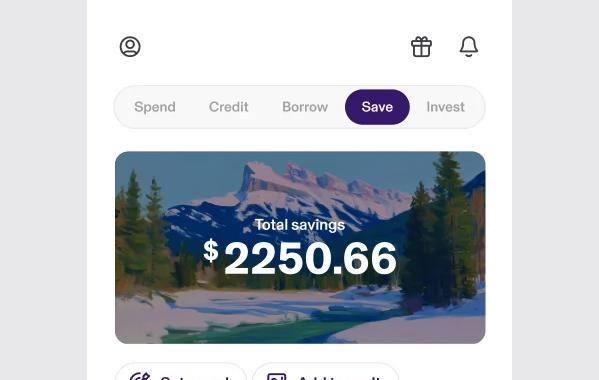
Earn up to 3.5% interest on every dollar of your savings
When comparing accounts, confirm what “unlimited” actually includes. Some accounts allow unlimited everyday transactions without charging a fee but still impose dollar limits, transfer limits or restrictions on specific services.
The best account should combine a competitive interest rate with practical access to your money, transparent fees and transaction features that match how you bank.
However if you want high interest savings with unlimited transactions, KOHO is one of the strongest options in Canada.
KOHO
It is a prepaid Mastercard, so you spend your own money while still earning high interest.
With KOHO High Interest Savings, you can:
- Grow your savings up to 3.5% interest
- Earn a 2% cash back rate on groceries, eating, drinking, and transportation and 0.5% cash back on everything else
- Unlimited transactions and free e-transfers
- No minimum balance required, ever
What Is a High-Interest Savings Account With Unlimited Transactions?
A high-interest savings account pays interest on your balance while allowing you to move or spend your money without paying for every transaction.
Unlimited transactions may include:
- Electronic transfers between accounts
- Bill payments
- Pre-authorized debits
- Debit or prepaid card purchases
- Interac e-Transfer®
- Withdrawals
- Transfers to linked accounts
The included transaction types depend on the account. An institution may advertise unlimited transactions while excluding ATM withdrawals, wire transfers, foreign transactions or certain assisted services.
This differs from a traditional savings account, which may include only a limited number of withdrawals or transfers. The Financial Consumer Agency of Canada notes that most savings accounts limit transactions or charge fees for certain withdrawals and transfers.
Why Choose an Account With Unlimited Transactions?
A traditional savings account works well when you rarely move your money. It becomes less practical when you regularly transfer funds, pay bills or withdraw from the account.
An account with unlimited transactions may be useful when you want to:
- Earn interest on your everyday balance
- Make frequent transfers without additional fees
- Pay bills directly from the account
- Use one account for saving and spending
- Move money between savings goals
- Receive and send Interac e-Transfer®
- Access emergency savings without withdrawal penalties
The account can reduce the need to keep most of your money in a non-interest-bearing chequing account.
However, easy access can also make savings easier to spend. Consider separating long-term savings into goals or a different account if you are likely to use the money impulsively.
Does Unlimited Really Mean Unlimited?
Usually, “unlimited transactions” means the provider does not charge a fee based on the number of included transactions you make.
It does not necessarily mean there are no limits at all.
An account may still have:
- A maximum amount per transaction
- Daily transfer limits
- Weekly or monthly dollar limits
- ATM withdrawal limits
- Interac e-Transfer® limits
- Limits on deposits or account funding
- Restrictions on international transfers
- Fraud-prevention or security limits
For example, you may be allowed to send as many qualifying transfers as you need without a per-transfer fee while still being restricted to a maximum dollar amount each day.
Review the account’s fee schedule and transaction-limit page separately. The fee schedule tells you what transactions cost, while the limit page tells you how much money you can move.
High-Interest Savings Account vs. Interest-Paying Chequing Account
An account with high interest and unlimited transactions often combines elements of traditional savings and chequing accounts.
Traditional High-Interest Savings Account
A traditional savings account may offer:
- A competitive savings rate
- Limited withdrawals
- Few payment features
- No connected payment card
- Fees after a certain number of transactions
It may be better for money you want to leave untouched.
Interest-Paying Everyday Account
A combined spending and savings account may offer:
- Interest on the account balance
- Unlimited eligible transactions
- Bill payments
- Interac e-Transfer®
- Direct deposit
- A connected card
- Pre-authorized debits
This may be more convenient for everyday banking, although the interest rate may differ from a standalone promotional savings account.
The Financial Consumer Agency of Canada notes that chequing accounts generally provide more day-to-day transaction services, while savings accounts usually pay interest but may have more limited transaction access.
Compare the Ongoing Rate, Not Just the Promotion
A promotional rate may look significantly higher than the account’s regular rate.
Before opening an account, determine:
- Whether the rate is promotional or ongoing
- How long the promotion lasts
- Which deposits qualify
- Whether the offer applies only to new customers
- The maximum balance eligible for the rate
- What rate applies afterward
A temporary high rate can be worthwhile when you plan to move a large balance for several months. It may be less useful for an everyday account you intend to keep for several years.
An ongoing variable rate has no fixed promotional expiry date, but the provider can still change it.
Check Whether the Rate Has Conditions
The highest advertised interest rate may require you to complete specific actions.
Possible requirements include:
- Setting up direct deposit
- Adding a minimum amount each month
- Paying for a premium plan
- Maintaining a minimum balance
- Holding other products with the institution
- Qualifying as a new customer
- Depositing only new money
- Keeping the balance below or above a threshold
Calculate the rate you will realistically receive rather than assuming you qualify for the largest number in the advertisement.
How Much Can Transaction Fees Cost?
A savings account may appear free until you begin moving money.
For example, making six monthly withdrawals at $5 each would cost $30 per month or $360 per year. That could eliminate a substantial portion of the interest earned on a smaller balance.
When comparing accounts, review fees for:
- Withdrawals
- Transfers
- Bill payments
- Interac e-Transfer®
- Pre-authorized debits
- ATM use
- Assisted transactions
- Monthly account access
- Account inactivity
A slightly lower interest rate with unlimited free transactions may produce more value than a higher rate attached to frequent fees.
How Much Interest Could You Earn?
Your interest earnings depend on your balance, rate and how long the money remains in the account.
For example, if the rate remained unchanged for one year:
- $1,000 at 3% would earn approximately $30
- $5,000 at 3% would earn approximately $150
- $10,000 at 3% would earn approximately $300
- $25,000 at 3% would earn approximately $750
Actual earnings may differ because rates can change, balances fluctuate and interest may compound.
If you use the account for everyday transactions, your daily balance will rise and fall. The interest earned will reflect the amount actually held in the account during the calculation period.
Can You Use One Account for Chequing and Savings?
Yes, provided the account supports the transaction features you need.
Using one interest-paying account may help you:
- Keep more money earning interest
- Avoid transfers between chequing and savings
- Simplify account management
- Reduce transaction fees
- View spending and savings in one place
The disadvantage is that your savings remain highly accessible.
You can reduce the temptation to spend by:
- Creating separate savings goals
- Keeping only bill money in the spendable balance
- Automating transfers into savings
- Maintaining a separate emergency fund
- Turning on balance and spending notifications
The best structure depends on whether convenience or separation helps you manage money more effectively.
Is This Type of Account Good for an Emergency Fund?
An account with interest and unlimited transactions can be a practical place for an emergency fund because it keeps money accessible without charging for a necessary withdrawal.
The Financial Consumer Agency of Canada recommends keeping emergency savings in an account that earns interest, permits quick access and has no or low transaction fees.
Before using the account for emergencies, check:
- How quickly you can transfer money out
- Whether weekends or holidays cause delays
- Whether there are withdrawal limits
- Whether ATM access is available
- Whether emergency withdrawals trigger fees
- Whether the money is protected by deposit insurance
An emergency account should prioritize accessibility and reliability over earning the absolute highest possible rate.
Is Your Money Deposit-Protected?
Confirm where the institution holds your money and whether the deposits are eligible for Canada Deposit Insurance Corporation protection.
CDIC generally protects eligible deposits up to $100,000, including principal and interest, in each insured category at each member institution.
Coverage depends on:
- Whether the institution is a CDIC member
- Whether the deposit is eligible
- The account’s legal structure
- The insurance category
- Other deposits you hold in that category
- Whether funds are held directly or through a trust arrangement
A financial app may not be a bank itself. Review its deposit-protection disclosure to identify which member institution holds customer funds.
Do You Pay Tax on the Interest?
Interest earned in a regular non-registered savings account generally forms part of your taxable income and must be reported on your tax return.
Interest earned inside a TFSA is generally tax-free, subject to the account’s contribution and eligibility rules.
A non-registered account may still be more convenient for everyday transactions because it does not involve TFSA contribution-room considerations.
Choose the account structure based on how you intend to use the money rather than focusing only on tax treatment.
What Other Fees Should You Review?
Unlimited transactions do not necessarily make the entire account free.
Potential charges may include:
- Monthly plan fees
- Foreign transaction fees
- Currency conversion costs
- Out-of-network ATM fees
- Replacement card fees
- Wire transfer fees
- International transfer fees
- Paper statement fees
- Overdraft or NSF charges
A monthly plan may still provide value when its interest, rewards and included services exceed the cost. Calculate that value using the balance and transactions you realistically expect to maintain.
Who Should Consider This Type of Account?
A high-interest account with unlimited transactions may be useful if you:
- Maintain a large everyday account balance
- Make frequent transfers
- Want interest without limiting access
- Prefer digital banking
- Regularly send Interac e-Transfer®
- Want to combine spending and saving
- Dislike paying per-transaction fees
- Need flexible access to an emergency fund
A traditional savings account may be more suitable when you want stronger separation from everyday spending and rarely withdraw money.
Unlimited Transactions Should Still Come With Transparent Limits
The best high-interest savings account with unlimited transactions should let you earn interest without charging every time you move or spend your money.
However, unlimited does not mean unrestricted. Providers may still impose maximum transaction amounts, daily transfer limits and separate charges for services such as ATM withdrawals, wires or foreign transactions.
Compare the ongoing interest rate, included transaction types, account fees and deposit protection before opening an account. The strongest option is one that earns interest while supporting the way you already receive, save and use your money.

About the author
Quan works as a Junior SEO Specialist, helping websites grow through organic search. He loves the world of finance and investing. When he’s not working, he stays active at the gym, trains Muay Thai, plays soccer, and goes swimming.
Read more about this author