

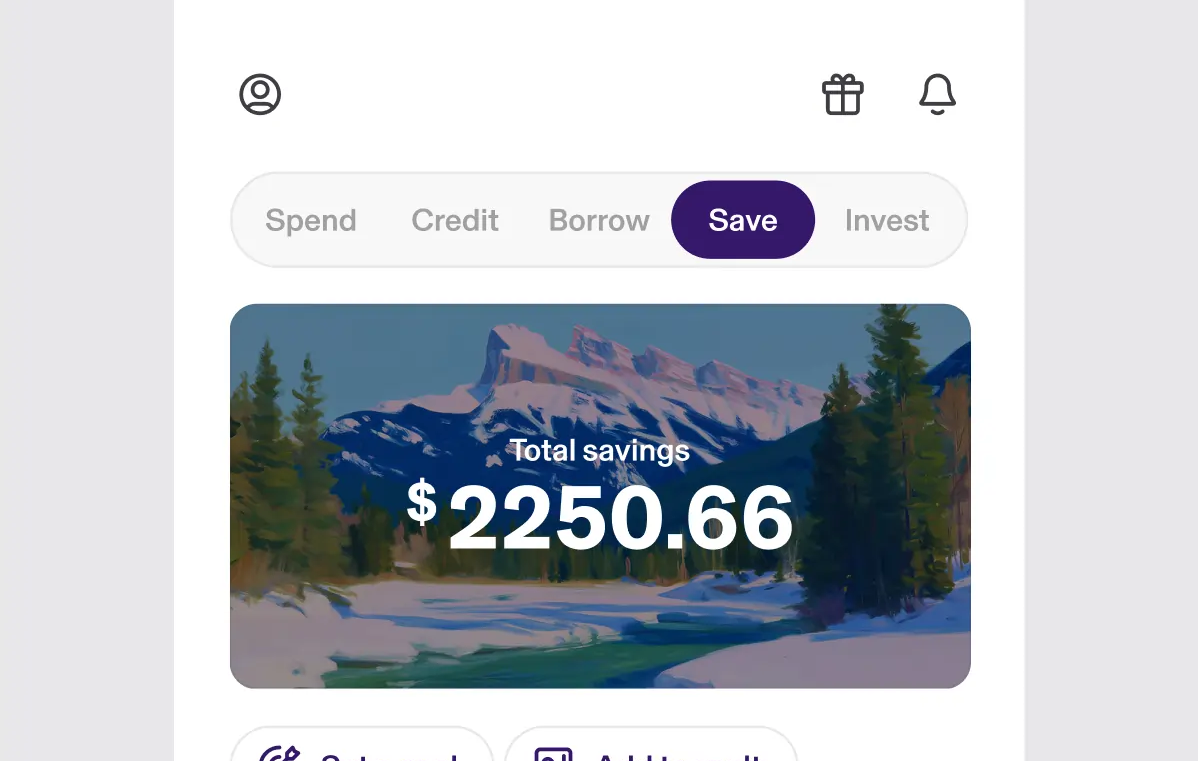
Earn up to 3.5% interest on every dollar of your savings
The best no penalty account should let you access your savings without an early-withdrawal charge, forfeiting the interest you have already earned or waiting for a fixed term to end.
However, “no penalty” does not necessarily mean every transaction is free. The account may still charge for withdrawals, transfers, ATM use or other services.
However if you want top high interest savings with no penalty, KOHO is one of the strongest options in Canada.
KOHO
It is a prepaid Mastercard, so you spend your own money while still earning high interest.
With KOHO High Interest Savings, you can:
- Grow your savings up to 3.5% interest
- Earn a 2% cash back rate on groceries, eating, drinking, and transportation and 0.5% cash back on everything else
- Unlimited transactions and free e-transfers
- No minimum balance required, ever
What Is a No-Penalty High-Interest Savings Account?
A no-penalty high-interest savings account pays interest while allowing you to withdraw money without an early-redemption penalty.
Unlike a non-redeemable guaranteed investment certificate, your savings are not locked away for a fixed period. You can generally add or remove money as your needs change.
This makes the account useful for savings that need to remain accessible, including:
- Emergency expenses
- A home down payment
- Travel
- Annual tax payments
- Home or vehicle repairs
- Short-term financial goals
- Irregular business expenses
Savings accounts commonly pay interest, but they may provide fewer transaction services or charge higher day-to-day transaction fees than chequing accounts.
The right account therefore needs to balance interest with accessibility.
What Does “No Penalty” Actually Mean?
“No penalty” usually means you will not lose previously earned interest or pay an early-withdrawal charge when you take money out.
This is different from an account being completely free.
You may still encounter:
- Withdrawal fees
- Electronic transfer fees
- ATM charges
- Monthly account fees
- Account-closing fees
- Foreign exchange costs
- Non-sufficient-funds fees
- Limits on the amount you can transfer
Read the fee schedule instead of relying only on the term “no penalty.”
A provider might allow withdrawals at any time but charge $5 for each transaction. Technically, there is no early-withdrawal penalty, but frequent access could still become expensive.
No-Penalty Savings Account vs. GIC
Both products can pay interest, but they provide different levels of access.
No-Penalty Savings Account
A savings account generally offers:
- Flexible deposits
- Flexible withdrawals
- A variable interest rate
- No maturity date
- No early-redemption penalty
- Easier access during an emergency
Non-Redeemable GIC
A non-redeemable GIC generally offers:
- A fixed investment term
- A guaranteed interest rate
- Limited or no early access
- A defined maturity date
- Possible loss of interest when early redemption is permitted
A GIC can be useful for money you know you will not need during the term. A flexible savings account is usually more practical for money that may need to be withdrawn without notice.
A cashable or redeemable GIC may allow early withdrawals, but it can still have minimum holding periods, reduced interest or other redemption conditions.
Who Should Consider a No-Penalty Account?
A no-penalty high-interest savings account may be appropriate when accessibility matters as much as earning interest.
It may be particularly useful if you:
- Are building an emergency fund
- Expect to withdraw money within a few years
- Have an irregular income
- Want to avoid locking in your savings
- Are saving for several short-term goals
- Need a place for temporary cash
- Want to move your money when rates change
- Do not want to risk market losses
It may be less suitable for long-term money that you could invest or lock into a higher fixed rate without needing immediate access.
Look for an Ongoing Interest Rate
Savings accounts may advertise either promotional or ongoing rates.
Promotional Rate
A promotional rate is available for a limited period. It may apply only to:
- New customers
- New deposits
- Accounts opened before a deadline
- Balances below a maximum
- A specific introductory period
A promotion can be valuable when you already have a larger amount ready to deposit. However, the rate may fall considerably when the offer ends.
Before opening the account, check:
- How long the promotion lasts
- When the promotional period begins
- Which deposits qualify
- Whether withdrawals affect eligibility
- The maximum qualifying balance
- The regular rate after the promotion
A temporary rate should not be treated as the account’s long-term return.
Ongoing Rate
An ongoing rate has no stated promotional expiry date, but it is usually variable. The provider may raise or lower it as market conditions and its pricing change.
An ongoing rate may be better when you want to keep your savings in one place without repeatedly moving them between institutions.
Check Whether Withdrawals Reduce Your Rate
Some savings accounts allow withdrawals without charging a direct fee but reduce the interest rate when you take money out.
For example, an account could offer a bonus rate only when you:
- Make no withdrawals during the month
- Increase your balance each month
- Maintain a specified minimum
- Keep the money deposited for a certain period
The withdrawal is technically permitted, but you may lose part of the interest you expected to earn.
Ask whether withdrawing money will:
- Cancel a promotional rate
- Remove a monthly interest bonus
- Move the account into a lower rate tier
- Affect the complete balance or only the amount withdrawn
- Change your eligibility for future bonuses
A true no-penalty option should not make an ordinary withdrawal unexpectedly expensive.
Look for Free or Low-Cost Withdrawals
The best account should allow you to access your money without a large transaction charge.
Check whether you can withdraw through:
- Interac e-Transfer®
- A linked bank account
- Electronic funds transfer
- Bill payment
- An associated spending account
- ATM withdrawal
- A connected payment card
Savings accounts may limit transactions or charge for withdrawals and transfers, so the details should be confirmed before opening one.
An account with a slightly lower rate may provide more value when withdrawals and transfers are free.
Consider How Quickly You Can Access the Money
Avoiding a penalty does not necessarily mean receiving the money immediately.
An external bank transfer may take several business days. Newly deposited money may also be subject to a holding period.
Review:
- Transfer-processing times
- Daily and weekly limits
- Weekend availability
- Interac e-Transfer® limits
- New-deposit holds
- ATM access
- Whether instant transfers cost extra
Fast access is particularly important when the account holds your emergency fund.
You may choose to keep part of your savings in an account with immediate access and the remainder in an account that takes slightly longer to transfer.
Avoid Minimum-Balance Penalties
Some accounts require you to maintain a minimum balance to earn interest or avoid a monthly charge.
A minimum-balance account may be difficult to use for emergencies because withdrawing money could:
- Reduce your interest rate
- Trigger an account fee
- Remove a rate bonus
- Make the remaining balance ineligible for interest
An account without a minimum is generally more flexible, especially when you are gradually building your savings or expect the balance to fluctuate.
Compare the Net Return After Fees
The highest interest rate does not always generate the highest return.
Suppose an account pays a slightly higher rate but charges a $10 monthly fee. That fee costs $120 per year.
A 1% improvement in your interest rate produces approximately:
- $10 more annually on $1,000
- $50 more annually on $5,000
- $100 more annually on $10,000
- $250 more annually on $25,000
On a $5,000 balance, paying $120 annually to earn an additional $50 in interest would leave you worse off unless the plan provides other valuable benefits.
Include monthly fees, withdrawal charges and transfer costs when comparing accounts.
Is a No-Penalty Account Good for an Emergency Fund?
Yes. A no-penalty high-interest savings account is often well suited to an emergency fund because the money can earn interest while remaining accessible.
The account should provide:
- Quick withdrawals
- No early-redemption penalty
- No market risk
- Low or no transaction fees
- Clear deposit protection
- Separation from everyday spending
An emergency fund should not be locked into a product that prevents you from accessing the money when an urgent expense occurs.
You can begin with a smaller target such as $500 or $1,000, then gradually work toward several months of essential expenses.
Keep Emergency Savings Separate
Easy access does not mean the money should sit in the account you use for everyday shopping.
Keeping the balance separate can help prevent it from being used for non-essential purchases.
You could use:
- A dedicated savings account
- Savings goals within an app
- A separate account without a payment card
- Automatic transfers after payday
- Separate funds for emergencies and planned expenses
The ideal account creates enough separation to discourage casual spending without making an actual emergency withdrawal difficult.
Are No-Penalty Accounts Safe?
High-interest savings accounts are generally considered lower-risk places to hold cash, but protection depends on where the funds are kept and whether the deposits are eligible for insurance.
The Canada Deposit Insurance Corporation protects eligible deposits if a member institution fails. Coverage generally applies up to $100,000, including principal and interest, in each insured category at each member institution. Deposit insurance is automatic.
Before opening an account, confirm:
- Which institution legally holds the money
- Whether it is a CDIC member
- Whether the product is an eligible deposit
- Which insurance category applies
- Whether you hold other deposits in the same category
- How coverage works if the account is offered through a fintech
CDIC protection may apply to funds managed through a fintech, but eligibility depends on how and where the money is held.
Should You Use a TFSA?
A high-interest savings account can sometimes be held within a Tax-Free Savings Account.
Interest and other eligible income earned inside a TFSA are generally tax-free, including when you make a withdrawal.
However, TFSA withdrawals require careful contribution-room management. Money withdrawn is generally added back to your available contribution room on January 1 of the following calendar year, not immediately. Re-contributing too soon can result in an overcontribution when you do not have other available room.
A TFSA may be appropriate when:
- You have available contribution room
- You want the interest to remain tax-free
- You understand the withdrawal rules
- The account provides suitable access
A non-registered account may be simpler when you expect to make frequent withdrawals and deposits.
Is Savings Interest Taxable?
Interest earned in a standard non-registered savings account generally forms part of your taxable income and must be reported on your tax return.
Your financial institution may issue a T5 slip showing the investment income earned. You are still responsible for reporting taxable interest even when you do not receive a slip.
Tax treatment should be considered, but it should not prevent you from keeping emergency or short-term savings in a secure and accessible account.
Can You Withdraw Money at Any Time?
Most flexible savings accounts allow withdrawals, but the method and speed can vary.
Before depositing a large amount, ask:
- Can I withdraw whenever I need to?
- Is there a fee for each withdrawal?
- Will I lose a bonus rate?
- Is there a daily transfer limit?
- How long does an external transfer take?
- Can I access money on weekends?
- Is there an ATM or card option?
- Does closing the account trigger a fee?
Some financial institutions may charge a fee when you close or transfer a savings account.
Testing the account with a small deposit and withdrawal can help you understand how it works before moving your complete savings balance.
Do No-Penalty Accounts Have Transaction Limits?
They may.
A no-penalty account might permit withdrawals without an early-redemption charge while still imposing:
- Daily transfer limits
- Monthly transaction allowances
- ATM withdrawal limits
- Maximum Interac e-Transfer® amounts
- Maximum external transfer amounts
- Limits on the number of linked accounts
The phrase “no penalty” describes the financial consequence of accessing the funds. It does not promise unlimited movement.
Review both the fee schedule and the transaction-limit disclosure.
Should You Chase Promotional Rates?
Moving your money between promotions can increase your interest earnings, but it also requires additional administration.
You may need to:
- Open several accounts
- Complete identity checks
- Link external institutions
- Monitor promotional deadlines
- Move money when offers expire
- Update automatic transfers
- Keep track of tax slips
Rate chasing may be worthwhile for a large balance because a small rate difference produces more interest.
For a smaller balance, simplicity and easy access may be more valuable than repeatedly moving the money for a modest increase.
What Features Should You Prioritize?
The strongest no-penalty account should provide:
A Competitive Rate
Compare the rate you will actually receive, not only the temporary headline offer.
No Early-Withdrawal Penalty
You should be able to access the principal without forfeiting previously earned interest.
Low Transaction Costs
Ordinary withdrawals and transfers should be free or inexpensive.
Fast Access
The transfer process should fit the purpose of the savings.
No Restrictive Minimum
Withdrawing money should not trigger an unexpected monthly charge or eliminate all interest.
Deposit Protection
Understand where the money is held and how eligible deposits are insured.
Simple Online Management
You should be able to view the balance, make transfers and change savings settings without unnecessary difficulty.
Automatic Savings
Recurring transfers can help you build the balance consistently.
How to Open a No-Penalty Account
A typical online application may require:
- Your personal and contact information
- Government-issued identification
- Tax residency information
- Your Social Insurance Number
- Identity verification
- A linked external account
- An initial deposit
Before moving your savings:
- Review the complete fee schedule.
- Confirm whether the rate is promotional.
- Check the withdrawal rules.
- Verify deposit-protection details.
- Test the transfer process with a small amount.
- Set up automatic contributions.
- Note when any promotional rate ends.
Do not move all your emergency savings until you are confident that the account works as expected.
No Penalty Should Mean Your Savings Remain Useful
The best no-penalty high-interest savings account should let your money earn interest without locking it away.
Look beyond the advertised rate. Confirm that withdrawing money will not eliminate a bonus, trigger a fee or require several days of waiting. Also review minimum-balance rules, transaction limits and deposit protection.
The strongest account is not simply the one paying the highest rate today. It is the one that keeps your savings accessible without quietly reducing their value through penalties, fees or restrictive conditions.

About the author
Quan works as a Junior SEO Specialist, helping websites grow through organic search. He loves the world of finance and investing. When he’s not working, he stays active at the gym, trains Muay Thai, plays soccer, and goes swimming.
Read more about this author